

Chili
Introduction
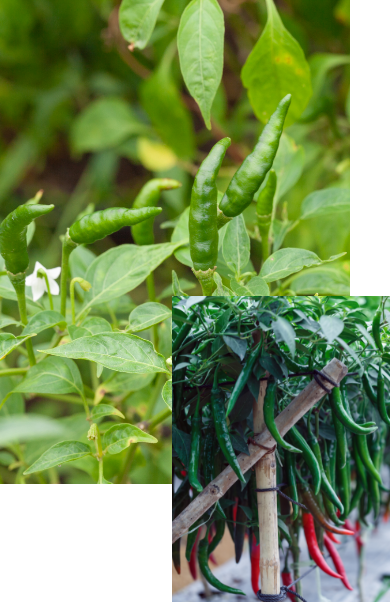
Chilies are produced seasonally but consumed throughout the year. The pods are marketed both in green and red or natural form. Its cultivation involves heavy labor and capital inputs. There exists a great scope for its export.Chili peppers are widely used in many cuisines as a spice to add heat to dishes. The substances that give chili peppers their intensity when ingested or applied topically are capsaicin and related compounds known as capsaicinoids. Chili peppers originated in Mexico.
Climatic Conditions
Chilies require warm and humid climate for growth and dry weather during maturity. The crop comes up well in tropical and sub-tropical regions but it has a wide range of adaptability and can withstand heat and moderate cold. It can be grown over a wide range of altitudes from sea level up to nearly 2,100 meters. It requires 25-32 ℃ temperature range. Heavy rainfall leads to rotting of the crop. Un-favorable temperatures lead to bud blossom and fruit drops.
Seed Rate:
200 g/acre for open variety; 80-100 g/acre for hybrids

Nursery Development
Nurseries are raised on well-prepared, metre wide and three meter long strip. Before broadcasting the seeds, straws or farm yard manure is burned on the strips after which seeds are broadcast and pressed in the soil and covered with a thin layer of soil. These are then covered with layers of straws supported by wooden sticks with water application in the morning and evening till the seeds germinate. After germination straw is removed and water is applied after every 4-5 days. Within six weeks seedlings become ready for transplanting.
Soil Conditions
Chilies are grown on soils with light sands to well drained clay. Silty and clay loam soils are better, while water-logged and alkali is not suitable. Soils selected are prepared thoroughly for getting good yields. As roots of chillies go one foot deep, therefore, deep ploughing is necessary. Two ploughing with mould board plow followed by global plow are done, levelling the soil for even distribution of water and fertilizer. About 30-40 cart loads of well rotten farm yard manure per acre are added one month before transplanting the chilies.
Land Preparation
Proper land preparation is very important to ensure a uniform stand and higher chili yield which can be achieved following below mentioned practices. Deep-turn soil at least three to four weeks prior to planting, using a moldboard plough. The soil should be ploughed to depth of 15 to 20 cm and one or two planking are sufficient to get good tilth and leveled seedbed. Land must be leveled in order to irrigate the plants properly. Although chili has limited root system but is very responsive to manures and commercial fertilizers.
Transplanting Of Seedlings
After land preparation, ridges of one and half foot high and wide are prepared. Transplanting is done on both sides of the ridges and distance between each plant is maintained at one and a half foot. Care is taken to avoid plants on both sides of ridges to face each other as this leads to dense plant population causing hindrances in weeding, harvesting, spraying etc. Transplanting is preferable done in the evening, because in the morning seedlings cannot withstand noon temperatures. After transplantation two rounds of watering are applied so that plants develop roots. Subsequent irrigation is applied as per climatic conditions.
Duration Of Crop
Total duration of chili crop is 150-180 days. And seed germinate within 4-7 days.
Varieties Of Chilli

Fertilizers
Recommended fertilizer dose for chilies is one bag of DAP and one of potassium sulphate before sowing, and two to three bags of urea, one bag is applied after 20 days of transplanting and the second at flowering stage, and third, if necessary, at fruit setting.
Irrigations
After transplantation two rounds of watering are applied so that plants develop roots. Subsequent irrigation is applied as per climatic conditions.
Harvesting
Green chillies are picked early in the morning or in the evening. These are protected from the sun to avoid quality deterioration. Ripe fruits are harvested at frequent intervals. Retaining fruits for a long period on the plant causes wrinkles and colour fading. Soon after the harvest, the produce is heaped or kept in clean gunnies for one day for uniform colour development of pods. Sun-drying is necessary to ensure complete dryness. Levelled and compacted floor is made for drying. From the fifth day onwards, the produce is inverted on alternate days so that pods in the lower layers are brought up to ensure quick and uniform drying. To avoid microbial activity and aflatoxin production, the moisture in dried pods need to be brought down to 10 per cent.
Post-Harvest Practices
Since the produce is exposed to sun for 10-15 days in open yards, it is likely to get contaminated with foreign matter. This also results in poor colour for the product due to the bleaching effect of sun-rays. The produce can be dried within a period of 18 hours by using air drier for maintaining the temperature at 44-46C. The method not only saves time of drying operation but also imparts deep red colour and glossy texture to the produce. Solar drier and tray drier can be used. While drying, the produce is covered with polythene sheets during night to avoid dew deposition and colour fading. Grading is done to remove defective and discoloured pods. Packing is done in gunny bags, or jute boras.
Pest Of Chili And Their Control
Fruit borer:
Fruit borer:
These are widely distributed pest observed throughout the world. It attacks on several crops like potato, chilli, beans, cotton, tobacco, curcurbit, castor, jute, coffee, lemon, citrus, blackgram, cowpea, pepper, tomato, sweet potato, mango, papaya, brinjal, guava. Nymphs and adults feed exclusively on the lower surface of the leaves. Infected leaves give cup shape appearance. Heavy infestation results in defoliation, bud shedding and drying of leaves.
If Infestation of yellow mite & thrips is observed in field, spray of Chlorfenapyr@1.5ml/Ltr, Abamectin@1.5ml/Ltr are found effective. Mite is a serious pest and it may cause yield loss up to 80%. For effective control spray Spiromesifen 22.9SC@200ml/acre/180Ltr of water.
Aphid:
They attack mostly in winter month and later stage of crop. They suck sap from the leaf. They excrete honey like substance and developed sooty mold i.e blackish colour fungus on the calyx and pods thus deteriorate quality of product. Aphids also work as important insect vectors for chilli mosaic. Mosaic disease transmitted by aphids cause 20-30 percent loss in yield. To control, take spray of Acephate 75SP@5gm/Ltr or Methyl demeton 25EC@2ml/Ltr of water. Soil application of granular insecticides viz Carbofuran, Phorate@4-8kg/acre on 15 and 60 days after transplanting were also effective.
White fly:
The nymphs and adults of White fly suck the cell sap from the leaves and weaken the plants. They secrete honey dew on which black sooty mould develops on leaves. They also transmit leaf curl diseases. To check infestation use yellow sticky traps coated with grease and sticky oils. In case of severe infestation to control take spray of Acetamiprid 20SP (@4gm/10Ltr of water or Triazophos@2.5ml/litre or Profenophos @2ml/litre of water. Repeat the spray after 15 days.
Disease And Their Control
Powdery Mildew:
Patchy, White powdery growth appears on lower side of leaves. It parasitizes the plant using it as a food source. It commonly occurs on older leaves just before or at fruit set. But it can develop at any stage of crop development. In severe infestation it causes defoliation.
Avoid water logging in field. Keep field clean. To control spray with Hexaconazole(Contaf, Sitara) along with sticker @1 ml/Ltr of water. Sudden rain can increase chances of powdery mildew. Mild infestation take spray of water soluble Sulphur @ 20 gm/10 Ltr of water 2-3 times with interval of 10 days.
Phytophthora blight:
It is caused by the fungus Phytophthora capsici. It is soil borne and commonly observed on soil with low drainage capacity and areas where proper cultural practices have not been maintained. Also, cloudy weather is favourable for spread of this disease.
Avoid crop rotation with brinjal, tomato, cucumber, pumpkin for at least three years. Spray with Copper oxychloride @250gm/150Ltr of water.
Thrips:
It is a commonly observed pest that is mostly appearing in dry weather. They suck sap from the foliage and results in curling of leaves and flower drop. To check severity of thrips incidence, keep blue sticky traps @6-8 per acre. Also, to reduce the incidence spray Verticillium lecani@5gm/Ltr water If incidence of thrips is higher, spray with Imidacloprid 17.8SL or Fipronil@1ml/Ltr water or Fipronil 80%WP@2.5ml/Ltr of water or Acephate 75% WP@1.0gm/Ltr or drench with Thiamethoxam 25% WG@1.0gm/Ltr of water.
Die back and fruit rot:
The branches and leaves get dried and black spots are formed on infected parts. Spots are usually circular, water-soaked and sunken with black margins. The fruits with many spots drop off prematurely resulting in heavy loss of yield. The disease spreads rapidly with blowing wind, rains during rainy season. Partially affected plants bear fruits which are few and of low quality.
Use disease free seeds. Before sowing seed treatment with Thiram or Captan@4gm/kg of seeds is effective in eliminating the seed borne inoculum. To control die back and fruit rot diseases spray with Mancozeb@2.5gm or Copper oxychloride@3gm per Ltr of water. Give first spray just before flowering and second at the time of fruit formation.
Wilt and damping off:
Moist and poorly drained soil causes damping off disease. It is soil borne disease. Water soaking and shrivelling of stem occurs and seedlings are killed before emergence. If it appears in nursery the entire lot of seedling may get destroyed. To control wilt, drench nearby soil with Copper oxychloride@250gm or Carbendazim@200gm/150Ltr of water. To control wilting of plants due to root rot, drench with Trichoderma bio fungus@2.5kg/500Ltr water, near to roots of plants.
Anthracnose:
It is caused by the fungi Colletotrichumpiperatum and C.capsici and is promoted by warm temperatures and high moisture. It is characterised by black spots that are formed on infected parts. Spots are usually circular, water-soaked and sunken with black margins. The fruits with many spots drop off prematurely resulting in heavy loss of yield. If infestation of Anthracnose is observed then spraying with Propiconazole or Hexaconazole @1ml/Ltr of water should be undertaken as a counter measure.
Yellow Mosaic:
Light and green patches observed on leaves. In early stage plant growth get stops. Yellowing, chlorotic ring spots on leaves and fruits. Select healthy and disease free seeds for cultivation. Avoid monocropping in chilly crop. Raise two rows of maize or sorghum For every five rows of chilly against wind direction. Uproot and destroyed infected plants away from field. Recommendations given for aphids may be adopted (i.e.,pray of Acephate 75SP@1gm/Ltr or Methyl demeton 25EC@2ml/Ltr of water. Soil application of granular insecticides, viz, Carbofuran, Phorate@4-8kg/acre should be done, 15 and 60 days after transplanting.
Bacterial Leaf Spot:
It is observed mostly in rainy season. On young leaves the spots are yellowish green, on older leaves they are dark and water soaked. Severely affected leaves become chlorotic and defoliation occurs. It observed on stem also. Stem infection leads to formation of cankerous growth and wilting of branches. On fruit round water soaked spots with pale yellow border is observed. To control various leaf spot and yellowing diseases, spray Propiconazole 25%EC@ 200ml or Chlorothalonil 75%WP @400-600gm per 150-200Ltr of water. If bacterial leaf spot infestation is observed, spray with Streptocycline@1gm +Copper oxychloride@400gm/200Ltr of water in order to control spread.